Salua Hamaza

Associate Professor

Director of the Biomorphic Intelligence Lab


About me

Prof. Salua Hamaza is Associate Professor of Aerial Robotics and Director of the BioMorphic Intelligence Lab at TU Delft, the Netherlands.

Her research focuses on drones that physically interact with the world. Her robotic solutions take inspiration from biological systems for flying and interaction tasks, with intelligence emerging first from the body itself and then through behaviour.
Research

My research lies at the intersection of design and control of drones capable of physical interaction with complex environments. I approach this from the perspective of embodied intelligence, where a robot’s capabilities emerge not only from control and cognition, but first and foremost from its morphology, mechanics, and sensing.

In all my work, everything begins with compliant mechanical design, which provides drones with physical bodies that can passively handle external stimuli and dynamic interactions. Building on this, I develop control algorithms tailored to aerial robots that physically interact with unknown objects and complex surroundings.

I believe intelligence in aerial robots starts with the body itself, from which higher-level control and cognitive intelligence naturally emerge. Often, my designs and behaviors are inspired by biological systems.

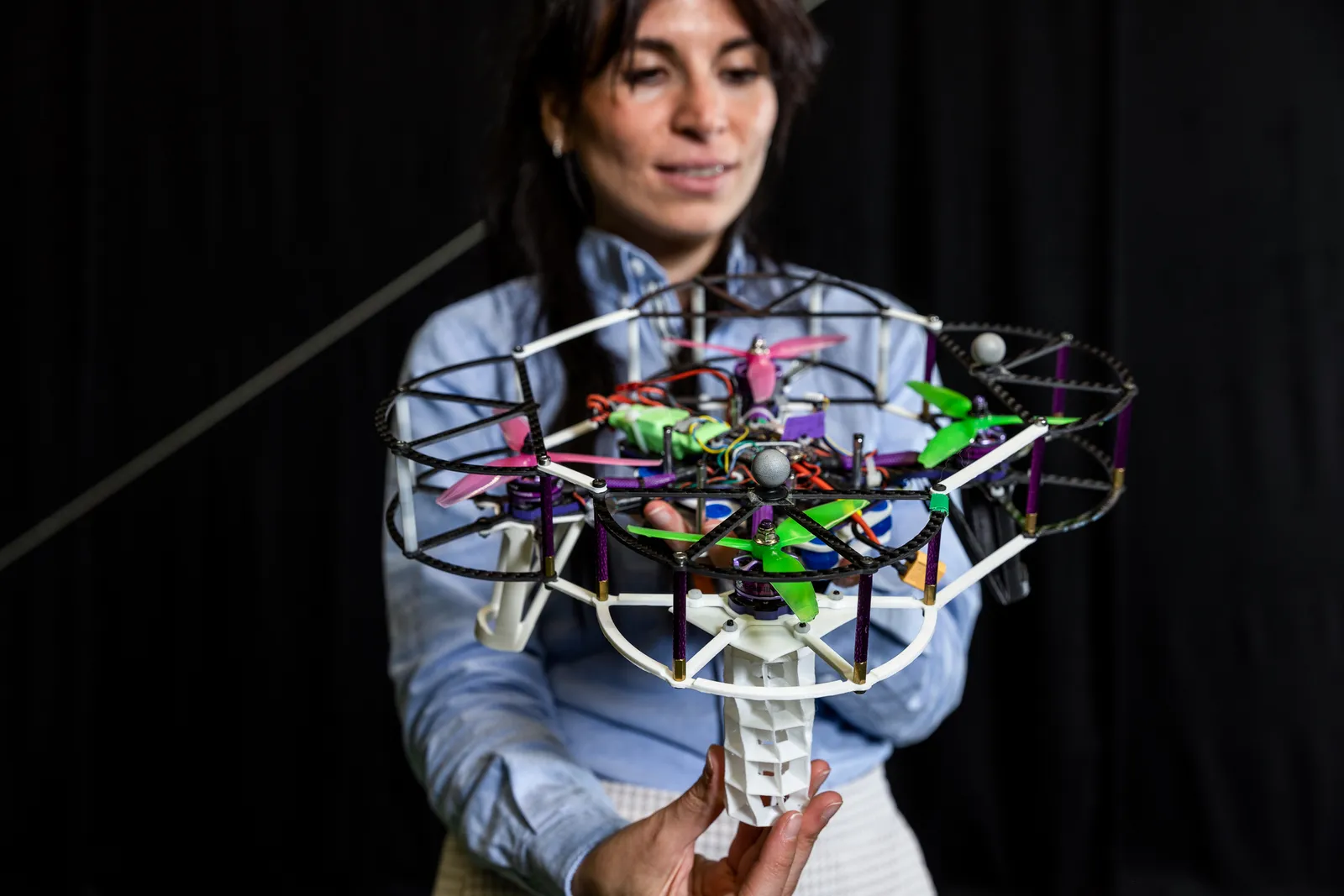
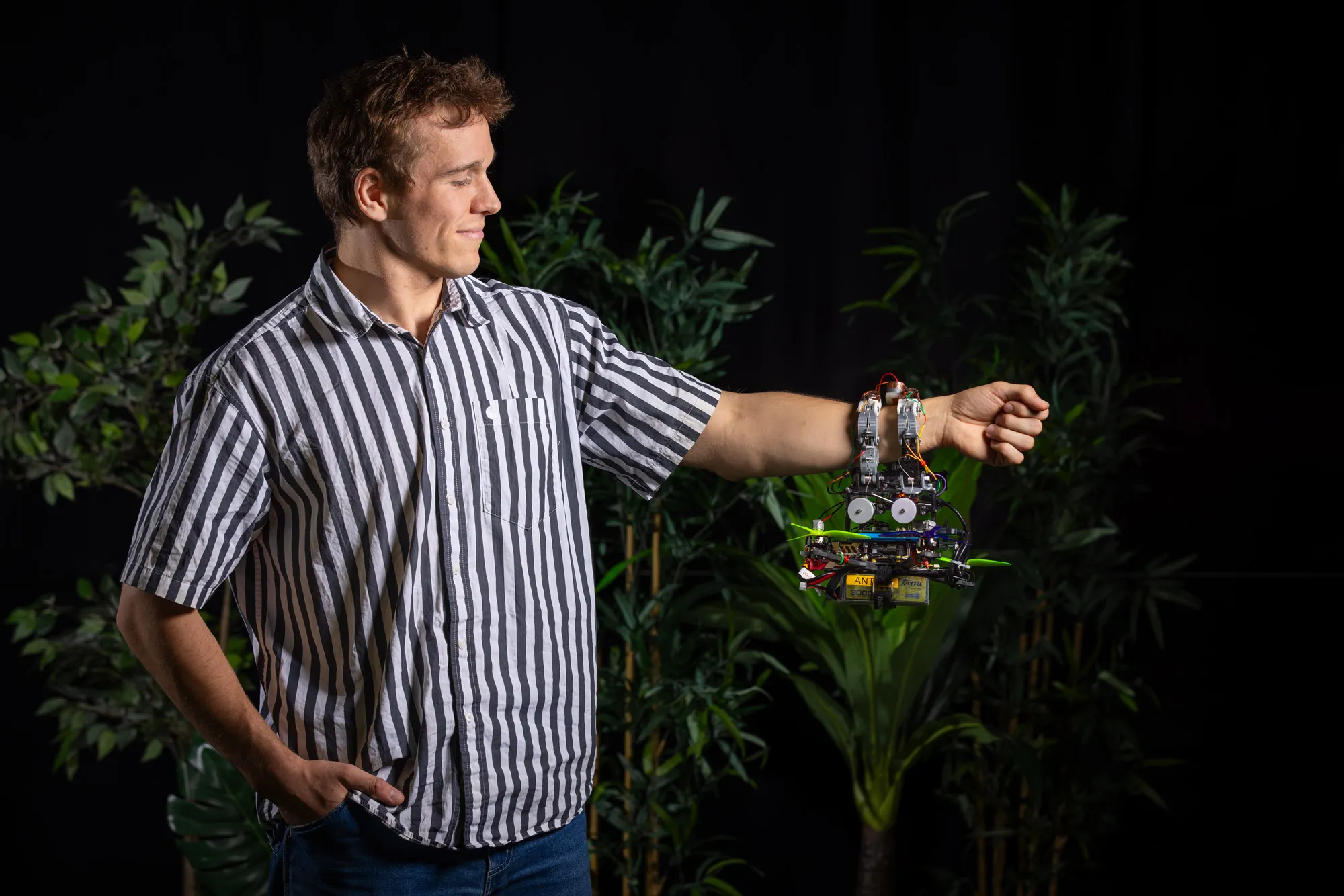
A researcher holding a drone with a soft tactile gripper that feels for a branch before landing

This drone feels its way to a safe landing, like a bird

A drone monitoring a rainforest could last much longer by landing on a branch and switching off its motors instead of continuously hovering. But reliable landings are difficult: as the drone approaches a branch, its own gripper can block the camera's view. Researchers at TU Delft have developed a drone that does something more like a bird: it feels for a branch before landing.

Flying squirrel drone reshapes drone design

Gliding silently through dense forests at night, flying squirrels perform some of the most agile aerial maneuvers found in nature. Unlike birds, which rely primarily on their feathered wings, gliding mammals reshape their entire body during flight. SquirrelDrone demonstrates for the first time how whole-body morphing dramatically improves flight perfomance via three key metrics, agility, maneuverability and stability.
Check out the publication in Nature Communications and the Youtube video.

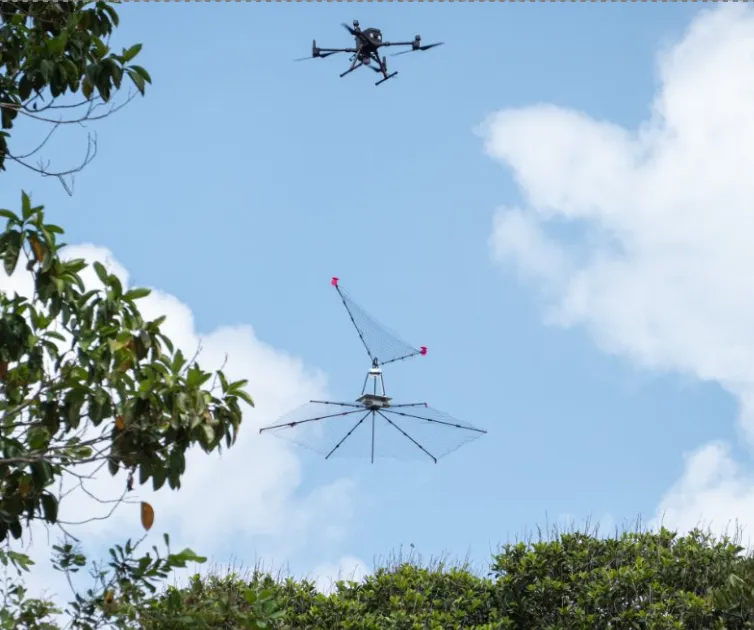
Drone used by the ETHBiodivX team in the XPRIZE Rainforest competition in Brazil

TU Delft jointly wins in XPRIZE Rainforest competition in Brazil

On November 15, 2024, after five years of intensive research and competition, the ETHBiodivX team, which included TU Delft Aerospace researchers Salua Hamaza and Georg Strunck, achieved an outstanding milestone: winning the XPRIZE Rainforest Bonus Prize for outstanding effort in co-developing inclusive technology for nature conservation.

Aerial robotics research at the Biomorphic Intelligence Lab

Impact

By combining innovative designs in embodied intelligence, robotics engineering can advance past the limits of traditional flight control via perception. Our research is set out to meet ecology needs, boosting biodiversity, integrating knowledge from multidisciplinary academics, entrepreneurs, and local communities and ultimately advise policy makers all around the world on what and where to take actions. TU Delft joins this mission to advance impact for a better planet and society.

Methodology

The research group at the BioMorphic Intelligence Lab headed by Salua focuses on enhancing drones’ autonomy by exploring new morphologies that enable higher mobility and versatility. This includes drones with limbs capable of climbing trees, building nests, cleaning forest floors, or collecting samples of foliage, bark, water, and soil.

Research archive →

Aerial robots are now ubiquitous. Thanks to their nimbleness, manoeuvrability, and affordability, drones are used in many sectors to monitor, map, and inspect. As a next step, flying robots offer more when interacting with their surroundings via anthropomorphic-like manipulation capabilities.

The BioMorphic Intelligence Lab, part of the TU Delft AI Labs programme, aims to tackle robustness and efficiency challenges for interacting drones, using biologically inspired solutions for both the 'body' and the 'brain' and applying embodied intelligence and neuromorphic AI techniques.

BioMorphic Intelligence Lab logo

Selected Publications

List of selected peer-reviewed work from the BioMorphic Intelligence Lab. A complete and continuously updated list is available on Google Scholar.

Full publication list on Google Scholar →

Contact

If you have any questions or would like to get in touch, please feel free to reach out via email.